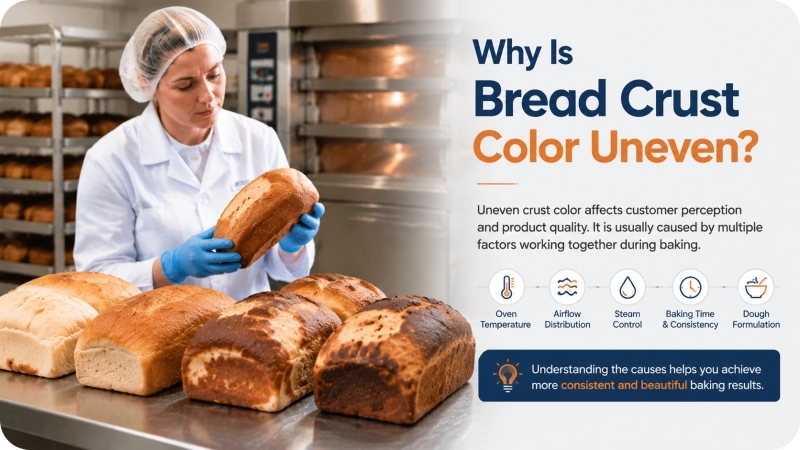
Una corteza dorada y atractiva es uno de los indicadores de calidad más importantes en los productos horneados. Los clientes suelen juzgar la calidad del pan antes de probarlo, y el color de la corteza influye notablemente en su percepción de frescura, textura y calidad de horneado.
Sin embargo, muchas panaderías se enfrentan a un problema común: la misma receta produce diferentes tonalidades de corteza en cada lote. Algunos panes pueden verse demasiado pálidos, mientras que otros desarrollan manchas oscuras, un dorado irregular o zonas quemadas. La coloración irregular de la corteza rara vez se debe a un solo problema. Comprender estos factores ayuda a las panaderías a mejorar la apariencia, reducir la variación del producto y lograr resultados de horneado más fiables.
¿Por qué el pan adquiere color durante el horneado?
Antes de solucionar el problema del dorado desigual, es importante comprender cómo el pan adquiere su color.
El color de la corteza del pan proviene principalmente de dos reacciones:
Reacción de Maillard
La reacción de Maillard se produce cuando los aminoácidos y los azúcares reductores reaccionan bajo el calor. Esto genera cientos de compuestos aromáticos y produce el atractivo color dorado característico del pan horneado.
Caramelización
La caramelización se produce cuando los azúcares se descomponen a altas temperaturas, creando colores más intensos y aromas dulces y tostados.
El color final de la corteza depende de:
• Temperatura de horneado •Tiempo de horneado •contenido de azúcar •Contenido de proteínas •Humedad de la masa • Condiciones de vapor
Cualquier cambio en estos factores puede influir en el aspecto final.
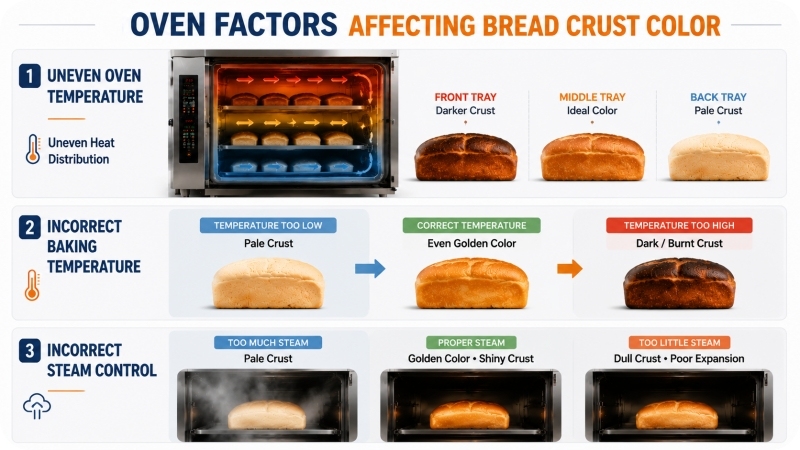
Causa 1: Distribución desigual de la temperatura del horno
Una de las causas más comunes de que la corteza tenga un color desigual es la temperatura inconsistente dentro del horno.
Los hornos industriales dependen de una transferencia de calor controlada. Si distintas zonas de la cámara de cocción tienen temperaturas diferentes, los productos colocados en distintas posiciones pueden cocinarse de forma diferente.
Los síntomas comunes incluyen:
Entre las posibles razones se incluyen:
Para las panaderías comerciales, una distribución uniforme del calor es esencial, ya que cientos de productos deben lograr la misma apariencia cada día.
Causa 2: Temperatura de horneado incorrecta
La temperatura influye directamente en la formación de la corteza terrestre.
Si la temperatura del horno es demasiado baja:
Si la temperatura del horno es demasiado alta:
La temperatura ideal para hornear depende del tipo de producto, la formulación de la masa, el tamaño y el contenido de humedad.
Un pan de molde y un pan rústico artesanal pueden requerir condiciones de horneado completamente diferentes, incluso si ambos están hechos con harina de trigo.
Causa 3: Control de vapor incorrecto
El vapor desempeña un papel importante durante la fase inicial del horneado.
En muchos productos de panadería, el vapor ayuda a mantener la superficie de la masa flexible, lo que permite una mejor expansión antes de que se forme la corteza.
Efectos del vapor:
• Espesor de la corteza •Brillo superficial •Desarrollo del color •Textura
Demasiado vapor puede retrasar el dorado y crear una costra pálida.
Una cantidad insuficiente de vapor puede provocar que la corteza se solidifique demasiado pronto, reduciendo la expansión y creando una apariencia opaca.
Las panaderías profesionales controlan cuidadosamente los niveles de vapor en función del producto que se está horneando.
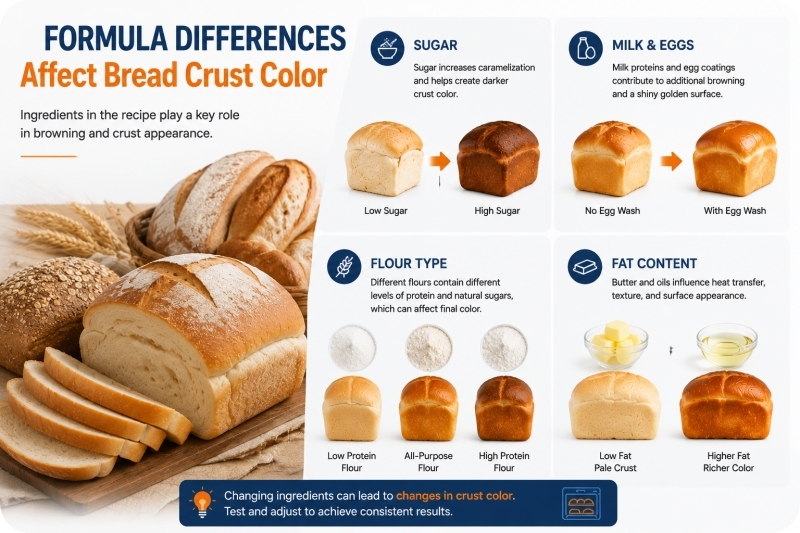
Causa 4: Diferencias en la fórmula
La receta en sí influye mucho en el color de la corteza.
Entre los ingredientes que influyen en el oscurecimiento se incluyen:
El azúcar aumenta la caramelización y ayuda a conseguir una corteza de color más oscuro.
Los panes dulces, el pan de leche y el brioche suelen dorarse más rápido que el pan magro.
Las proteínas de la leche y el recubrimiento del huevo contribuyen a reacciones de pardeamiento adicionales.
Por eso, los productos recubiertos con huevo batido suelen desarrollar una superficie dorada y brillante.
Las distintas harinas contienen diferentes niveles de proteínas y azúcares naturales, lo que puede afectar al color final.
La mantequilla y los aceites influyen en la transferencia de calor, la textura y el aspecto de la superficie.
Al cambiar los ingredientes, las panaderías deben prever posibles cambios en el color de la corteza.
Causa 5: Sobreimpresión y subimpresión
La fermentación también afecta al color de la corteza.
Masa sobrefermentada
La masa sobrefermentada suele tener una estructura más débil y puede producir:
• Costra pálida • Forma plana • Menor capacidad de expansión en el horno
Debido a que la estructura de la masa no puede expandirse adecuadamente, el desarrollo de la superficie cambia durante el horneado.
Masa poco fermentada
Una masa que no ha fermentado lo suficiente puede expandirse de forma excesiva en el horno y desarrollar una tensión superficial irregular.
Ambas situaciones pueden generar una apariencia inconsistente.
Una correcta revisión requiere el control de:
• Temperatura •Humedad •Tiempo •Estado de la masa
Causa 6: Carga y gestión del horno incorrectas
La forma en que se colocan los productos dentro del horno puede influir en los resultados.
Los errores comunes incluyen:
El aire necesita suficiente espacio para circular alrededor de los productos. Unas malas prácticas de carga pueden crear zonas calientes y frías.
Para la producción en grandes volúmenes, los operarios deben seguir procedimientos de carga estandarizados.
Conclusión
El color desigual de la corteza del pan suele indicar que uno o más aspectos del proceso de horneado no están completamente controlados. La solución no consiste simplemente en aumentar la temperatura del horno o prolongar el tiempo de cocción. Un color uniforme se consigue controlando conjuntamente los ingredientes, el desarrollo de la masa, la fermentación, las condiciones del horno y los procedimientos de producción.
Preguntas frecuentes
1. ¿Por qué la corteza de mi pan tiene un color desigual?
El color desigual de la corteza suele deberse a un calor irregular en el horno, una mala circulación del aire, un vapor incorrecto, una fermentación inconsistente, variaciones en la receta o una carga incorrecta de la bandeja.
2. ¿Por qué un lado de mi pan está más oscuro?
El oscurecimiento unilateral suele indicar una distribución desigual del calor, una mala posición de la bandeja, una obstrucción del flujo de aire o un desequilibrio en la carga del horno.
3. ¿Puede la fermentación provocar un color desigual en la corteza?
Sí. Una masa con fermentación insuficiente, con fermentación excesiva o secada superficialmente puede dorarse de forma diferente durante el horneado.
4. ¿Cómo pueden las panaderías comerciales corregir el dorado desigual?
Deben comprobar la calibración del horno, el flujo de aire, los ajustes de vapor, la separación entre bandejas, la humedad de fermentación, la precisión de la fórmula y el color del producto según la posición en el horno.
5. ¿Debo hornear el pan durante más tiempo para corregir que quede pálido?
No siempre. Un horneado más prolongado puede oscurecer demasiado otras zonas. Averigüe la causa del problema antes de modificar el tiempo de horneado.
¿Busca resultados de horneado más consistentes?
Con47 años de experiencia en fabricación.yExporta a más de 120 países.Ayudamos a las panaderías a mejorar la consistencia de sus productos y la eficiencia de su producción.

HONGLINGOfrece soluciones completas para panadería, incluyendo: • Laminadoras de masa• Fermentadoras de masa• Hornos rotatorios de carro• Hornos de piso • Mezcladoras espirales •Soluciones de refrigeración
suscríbase a nosotros, puede obtener el contenido de nuestro producto más reciente, noticias y actualizaciones exclusivas, los últimos eventos locales


online service






 +8613066853339