
La levadura hace que la masa de pan suba al fermentar los azúcares disponibles y liberar dióxido de carbono. También produce etanol y compuestos aromáticos que contribuyen al carácter del pan. Sin embargo, la levadura no construye toda la hogaza por sí sola: la masa debe retener ese gas y el horneado debe fijar la estructura expandida.
Para una panadería comercial, entender estos trabajos separados ayuda a explicar por qué añadir más levadura no soluciona automáticamente el pan denso. El mezclado, la temperatura de la masa, el tiempo de fermentación y la carga del horno afectan el resultado. Esta guía explica qué aporta la levadura y cómo gestionar su actividad en una producción repetible.
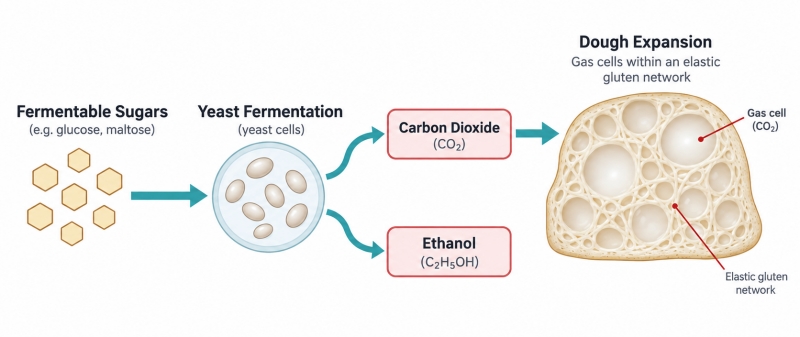
La levadura de panadero es un microorganismo vivo, comúnmente Saccharomyces cerevisiae. En la masa, utiliza azúcares fermentables y produce dióxido de carbono y etanol a través de la fermentación. El dióxido de carbono expande las celdas de gas dentro de la masa, aumentando su volumen.
Esos azúcares no tienen que provenir de azúcar de mesa añadido. La harina contiene algunos azúcares, y las enzimas descomponen porciones de su almidón en carbohidratos más pequeños, incluyendo azúcares que la levadura puede utilizar. La levadura no consume simplemente el almidón intacto de la harina directamente. Es por esto que el pan magro hecho sin azúcar añadido puede subir de todos modos.
La producción de gas continúa durante la fermentación en bloque y el levado final mientras las condiciones favorezcan la actividad de la levadura. Durante el inicio del horneado, la expansión del gas y el vapor de agua contribuyen al salto de horno; la actividad de la levadura se detiene finalmente cuando el calor inactiva las células. La gelatinización del almidón y los cambios en las proteínas ayudan entonces a establecer la estructura de la hogaza.
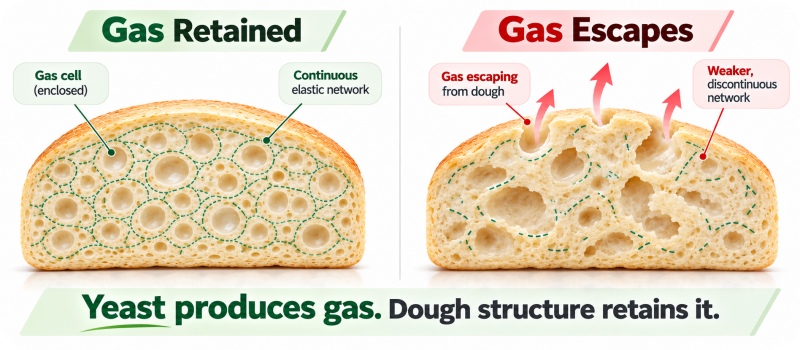
La producción de gas y la retención de gas son diferentes
En el pan de trigo, las proteínas de la harina hidratada forman una red de gluten que se desarrolla mediante el mezclado y el reposo. Esta red ayuda a retener el gas producido durante la fermentación. La levadura suministra gas, pero no puede compensar una masa que carece de la fuerza adecuada o que ha sido mal desarrollada.
Por lo tanto, una masa puede contener levadura activa y aun así producir una hogaza de bajo volumen. El gas puede escapar porque la estructura es débil, o una manipulación brusca puede dañar las piezas formadas. Por el contrario, una masa fuerte con una fermentación insuficiente puede permanecer compacta.
La estructura de la miga refleja ambos procesos. El pan de molde fino y una hogaza artesana abierta necesitan fórmulas y manipulaciones diferentes, aunque la levadura contribuya a ambos. Evalúe el desarrollo de la masa, la fermentación y el formado en conjunto en lugar de tratar cada miga densa como evidencia de levadura muerta.
Lo que la fermentación añade al sabor
La fermentación crea compuestos que contribuyen al aroma e influyen en el sabor desarrollado durante el horneado. La cepa de levadura, la harina, la temperatura y el tiempo afectan esa contribución. Una masa que alcanza el volumen requerido rápidamente no tiene necesariamente el mismo sabor que una que sigue un programa más largo y controlado.
Más largo no es automáticamente mejor. Una fermentación excesiva puede llevar a la masa más allá de su manipulación y perfil de sabor previstos. Elija un programa que se adapte al producto, luego evalúe las muestras horneadas en lugar de asumir que un proceso más lento siempre gana.
La masa madre añade otra distinción. Su comunidad microbiana contiene levaduras y bacterias de ácido láctico. Las levaduras contribuyen con gas, mientras que las bacterias son las principales contribuyentes a la acidificación. No se debe esperar que la levadura de panadero comercial por sí sola reproduzca el mismo perfil de masa madre.
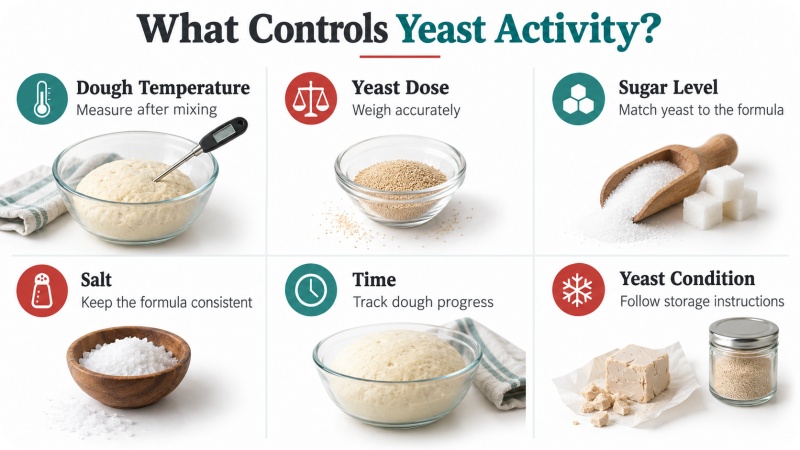
Qué condiciones cambian la actividad de la levadura
La temperatura es un control importante. Dentro de las condiciones normales de fermentación del pan, la masa más cálida generalmente fermenta más rápido y la masa más fría más lentamente. Registre la temperatura después del mezclado: la pantalla de la cámara de fermentación describe el aire del armario, no la temperatura real dentro de la masa.
La concentración de azúcar también importa. Pequeñas cantidades de azúcar disponible favorecen la fermentación, pero las altas concentraciones de azúcar crean estrés osmótico y pueden ralentizar la levadura común. Los productos dulces pueden beneficiarse de una cepa de levadura diseñada para esas condiciones. Más azúcar no siempre significa una subida más rápida.
La sal modera la fermentación y afecta las propiedades de la masa. Una omisión accidental de sal puede, por lo tanto, cambiar tanto el tiempo como la manipulación. Mantenga los pesos de los ingredientes precisos antes de ajustar la dosis de levadura.
El tiempo, la disponibilidad de agua, la condición de la levadura y la dosis completan el panorama. Evalúelos juntos. Añadir levadura para recuperar un programa retrasado puede acortar la ventana de levado sin abordar la causa original de la variación.
Elección y manipulación de la levadura comercial
La levadura fresca prensada, la levadura seca activa y la levadura instantánea son formatos comerciales diferentes. Sus necesidades de almacenamiento, instrucciones de preparación y tasas de aplicación típicas difieren. No las sustituya por peso igual a menos que la guía del proveedor respalde esa conversión.
La levadura instantánea se incorpora comúnmente directamente en los ingredientes secos. Los productos secos activos pueden requerir rehidratación; siga las instrucciones para el producto exacto en lugar de asumir que cada marca se comporta de forma idéntica. La levadura fresca normalmente requiere almacenamiento refrigerado y una rotación cuidadosa del stock.
Para la producción de masa enriquecida o congelada, discuta la aplicación con el proveedor de levadura. Seleccione un producto adecuado para la fórmula y el proceso, luego confírmelo en pruebas de producción. Registre el producto de levadura y el lote al investigar un cambio inesperado en la fermentación.
Conclusión
La levadura produce el gas que eleva la masa de pan y contribuye a su sabor, pero un pan consistente depende de cómo todo el proceso favorece la fermentación. Ajuste la levadura al producto, mida la temperatura de la masa, mantenga una fuerza de masa adecuada y siga el progreso del levado. Estos controles dan a los equipos de panadería una mejor base para tomar decisiones que cambiar la dosis de levadura cada vez que un lote parece diferente.
Preguntas frecuentes
¿La levadura de pan necesita azúcar añadido?
No necesariamente. La harina suministra algunos azúcares, y las enzimas hacen que azúcares fermentables adicionales estén disponibles a partir del almidón. Muchas fórmulas de pan magro fermentan sin azúcar añadido. La selección y cantidad de azúcar deben seguir la fórmula del producto.
¿La levadura crea gluten?
No. El gluten se desarrolla a partir de proteínas de trigo hidratadas mediante el mezclado y el reposo. La levadura produce gas que la estructura de la masa ayuda a retener, por lo que se necesitan tanto la fermentación como un desarrollo adecuado de la masa.
¿Añadir más levadura hará un mejor pan?
Más levadura puede acelerar la fermentación, pero no mejora automáticamente el sabor, la miga o el volumen. Puede hacer que la programación sea más difícil si la masa está lista antes que el horno. Ajuste la dosis mediante pruebas controladas.
¿La refrigeración detiene la levadura por completo?
La refrigeración ralentiza la fermentación en lugar de detenerla instantáneamente. La masa tarda tiempo en enfriarse, y algo de actividad puede continuar durante el mantenimiento en frío. Valide todo el programa de retardo para el producto y la carga.
¿Busca resultados de horneado más consistentes?
Con 47 años de experiencia en fabricación y exportaciones a más de 120 países, ayudamos a las panaderías a mejorar la consistencia del producto y la eficiencia de la producción.

HONGLING ofrece soluciones integrales de panadería que incluyen: • Laminadoras de masa • Cámaras de fermentación • Hornos rotativos de carro • Hornos de piso • Batidoras espirales • Soluciones de enfriamiento
Póngase en contacto con nuestro equipo hoy mismo para analizar su proyecto de panadería y recibir una solución personalizada..
Artículos relacionados
Bicarbonato de sodio vs. Polvo de hornear vs. Levadura: ¿Cuál es la diferencia?
Horno de piso vs. Horno de convección vs. Horno rotativo de carro
Batidora espiral vs. Batidora planetaria: ¿Cuál necesita su panadería?
Harina de fuerza vs. Harina de uso general: ¿Realmente importa?
Temperatura de la masa: El número oculto detrás de un pan consistente
suscríbase a nosotros, puede obtener el contenido de nuestro producto más reciente, noticias y actualizaciones exclusivas, los últimos eventos locales


online service






 +8613066853339