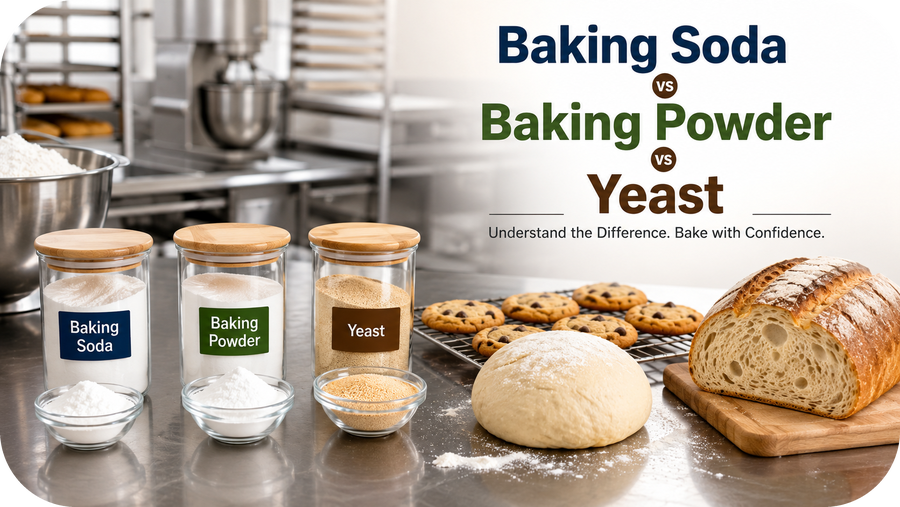
El bicarbonato de sodio, el polvo para hornear y la levadura ayudan a que los productos horneados suban, pero no funcionan de la misma manera. Generan gas mediante reacciones distintas, requieren condiciones diferentes y producen texturas y sabores diferentes. Para un panadero aficionado, la diferencia puede parecer un detalle menor en la receta. Para una panadería comercial, influye en el diseño de la fórmula, los tiempos de producción, la planificación del equipo y la consistencia del producto final.
Comprender estas diferencias no solo es útil para los panaderos caseros. En las panaderías comerciales, elegir el sistema de leudado adecuado influye en la mezcla, la planificación de la producción, la fermentación, la consistencia del producto e incluso los requisitos de equipamiento.
¿Cuál es exactamente la diferencia entre el bicarbonato de sodio, el polvo para hornear y la levadura?
¿Qué hace el bicarbonato de sodio?
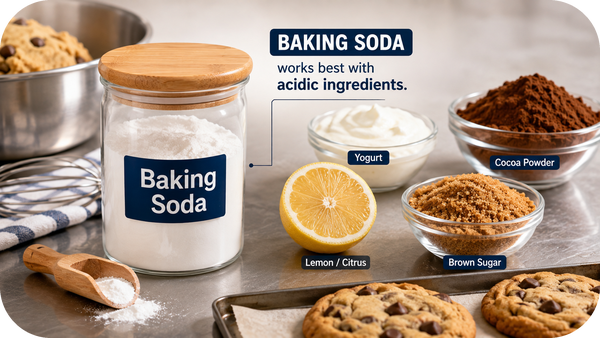
El bicarbonato de sodio es un agente leudante químico que libera dióxido de carbono al reaccionar con ácido y humedad. Este gas expande la masa, lo que ayuda a que los productos suban durante el mezclado y el horneado. Debido a que la reacción comienza rápidamente, los productos elaborados con bicarbonato de sodio generalmente deben hornearse poco después de mezclarlos.
El bicarbonato de sodio es útil en fórmulas que ya contienen ingredientes ácidos, como yogur, suero de leche, cacao natural, azúcar moreno, melaza, puré de frutas o ciertos saborizantes. También favorece el dorado, ya que eleva el pH, lo que estimula el desarrollo del color. Esta es una de las razones por las que algunas galletas y pasteles elaborados con bicarbonato de sodio se doran más intensamente.
El riesgo reside en el desequilibrio. Un exceso de bicarbonato de sodio o una cantidad insuficiente de ácido pueden generar un sabor jabonoso o amargo y una superficie demasiado oscura. En la producción comercial, el bicarbonato de sodio debe pesarse con precisión y mezclarse de manera uniforme, ya que pequeños errores pueden afectar el sabor, la dispersión, el color y la textura de toda la mezcla.
¿Qué hace el polvo para hornear?
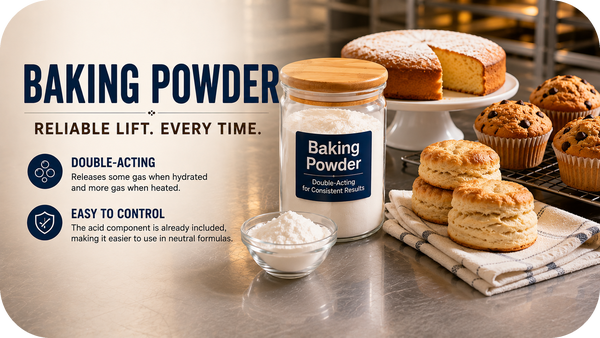
El polvo para hornear contiene bicarbonato de sodio, ácidos secos y un agente de almidón. Está diseñado para generar dióxido de carbono sin necesidad de un ingrediente ácido adicional en la fórmula. La mayoría de los polvos para hornear comerciales son de doble acción, lo que significa que liberan algo de gas al hidratarse y más gas al calentarse en el horno.
Esto hace que el polvo para hornear sea práctico para pasteles, magdalenas, panes rápidos, galletas, tortitas y otros productos que requieren una buena consistencia sin fermentación. Es más fácil de controlar que el bicarbonato de sodio en fórmulas neutras porque el componente ácido ya está incluido.
Sin embargo, el polvo para hornear no sustituye directamente a la levadura. Si bien facilita el levado, no fermenta la masa, no desarrolla el sabor del pan ni fortalece su estructura con el tiempo. Si se usa en exceso, los productos pueden levar rápidamente y luego desinflarse, o pueden adquirir un regusto químico. Los equipos de producción deben probar la dosificación cuidadosamente, especialmente al pasar de recetas pequeñas a lotes industriales.
¿Qué hace la levadura?
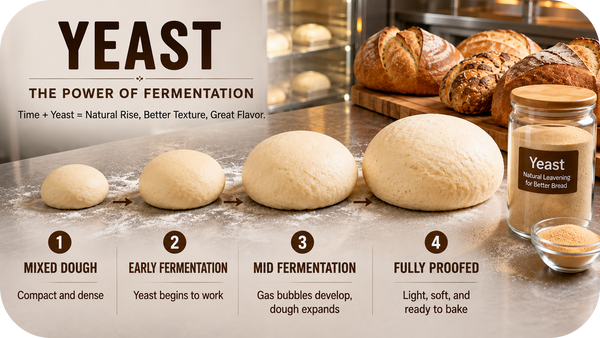
La levadura es diferente porque es un microorganismo vivo. Consume los azúcares de la masa y produce dióxido de carbono, alcohol y compuestos aromáticos. El dióxido de carbono expande la red de gluten, mientras que el tiempo de fermentación desarrolla el aroma, el sabor y la estructura de la miga.
La levadura es esencial para la mayoría de los panes, masas de pizza, bollos, panecillos, baguettes y otros productos de masa fermentada. A diferencia del bicarbonato de sodio o el polvo para hornear, la levadura necesita tiempo, control de temperatura y el entorno adecuado para la masa. La sal, el azúcar, la temperatura de la masa, la fuerza de la harina, la hidratación y la humedad durante la fermentación influyen en el rendimiento de la levadura.
En las panaderías comerciales, la levadura forma parte del proceso de producción. Si la fermentación es demasiado lenta, la producción disminuye. Si es demasiado rápida, la masa puede fermentar en exceso y perder consistencia. Una mezcladora, una cámara de fermentación y un horno controlados contribuyen a que la actividad de la levadura se traduzca en una calidad de producto uniforme.
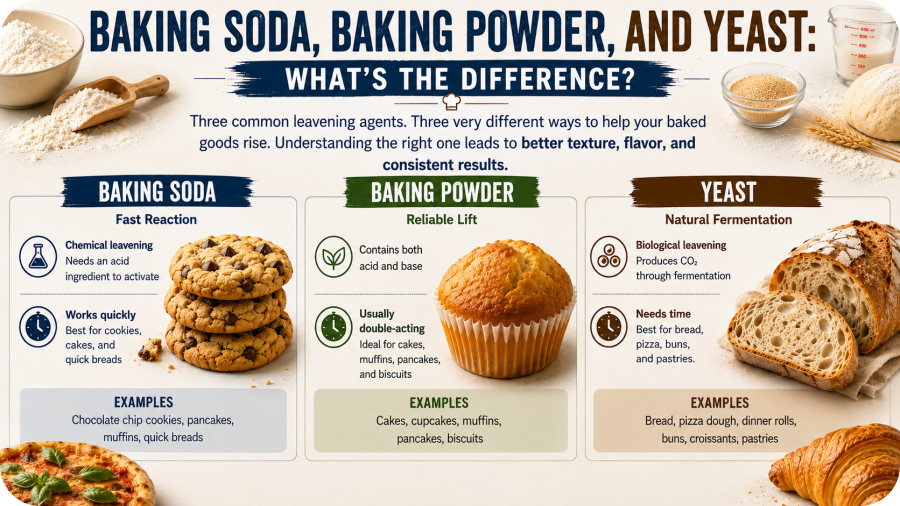
Cómo elegir el agente leudante adecuado
Utilice bicarbonato de sodio cuando la fórmula contenga ácido.
El bicarbonato de sodio funciona mejor cuando la fórmula incluye suficiente ácido para activarlo y equilibrar el sabor. Es común en galletas, algunos pasteles, panes de soda y productos con ingredientes ácidos. También puede ayudar a intensificar el color y a que se extienda mejor.
Utilice levadura en polvo para un levantamiento rápido y fiable.
El polvo para hornear es adecuado cuando el producto no depende de la fermentación. Es útil para pasteles, magdalenas, galletas, panes rápidos y muchos productos a base de masa donde la producción rápida y un levado uniforme son importantes.
Utilice levadura para la masa fermentada.
La levadura es la opción correcta cuando el producto necesita sabor a pan, expansión del gluten, textura masticable y estructura de fermentación. No es solo una fuente de gas; forma parte del desarrollo de la masa.
No sustituya a ciegas
Estos ingredientes no son sustitutos equivalentes. Cambiar de levadura a polvo de hornear altera el sabor, la textura, el tiempo de cocción y la identidad del producto. Cambiar entre bicarbonato de sodio y polvo de hornear altera la acidez y el dorado. Las panaderías comerciales deben realizar ensayos controlados antes de modificar sus fórmulas.
Preguntas frecuentes
1. ¿Cuál es la principal diferencia entre el bicarbonato de sodio, el polvo para hornear y la levadura?
El bicarbonato de sodio necesita ácido para liberar gas, el polvo para hornear contiene su propio sistema ácido y la levadura es un organismo vivo que fermenta la masa con el tiempo.
2. ¿Cuándo debe una panadería usar bicarbonato de sodio?
Utilice bicarbonato de sodio cuando la fórmula contenga ingredientes ácidos y cuando se desee un dorado más intenso o una mayor extensión, como en algunas galletas y pasteles.
3. ¿Cuándo debe una panadería usar levadura en polvo?
Utilice levadura en polvo para panes rápidos, pasteles, magdalenas, galletas y productos a base de masa que necesiten una buena consistencia sin fermentación.
4. ¿Por qué el exceso de bicarbonato de sodio tiene un sabor amargo?
Un exceso de bicarbonato de sodio o una cantidad insuficiente de ácido pueden dejar un sabor alcalino, jabonoso o amargo en el producto final.
¿Busca resultados de horneado más consistentes?
Con47 años de experiencia en fabricación.yExporta a más de 120 países.Ayudamos a las panaderías a mejorar la consistencia de sus productos y la eficiencia de su producción.

HONGLINGOfrecemos soluciones completas para panadería, que incluyen: • Laminadoras de masa • Fermentadoras de masa • Hornos rotativos de carro • Hornos de piso • Mezcladoras espirales • Soluciones de enfriamiento
suscríbase a nosotros, puede obtener el contenido de nuestro producto más reciente, noticias y actualizaciones exclusivas, los últimos eventos locales


online service






 +8613066853339